Short Bio
Robert Kudelić earned his doctorate by designing the first Monte Carlo randomized algorithm for the Feedback Arc Set problem. He is currently a professor with the Department for Theoretical and Applied Foundations of Information Sciences, Faculty of Organization and Informatics, University of Zagreb, Varaždin, Croatia. His research focuses on randomized algorithms, combinatorial optimization, computational intelligence, quantum computing, and information systems—including a contribution on quantum Monte Carlo algorithm for FAS, a framework for quantifying functional information, and the first comprehensive monograph on FAS.
He leads a Croatian Science Foundation project on algorithmic entrepreneurship and is co-head of the EconCS Laboratory. In 2026 he was on sabbatical at the University of Lisbon. He is a Senior Member of the IEEE, a member of European ACM SIGDOC, a Reviewing Editor for Springer Nature, and an Editor for the Journal of Computational Science, and has received Elsevier reviewing awards and a Dean's Award.
Areas of Expertise
Books
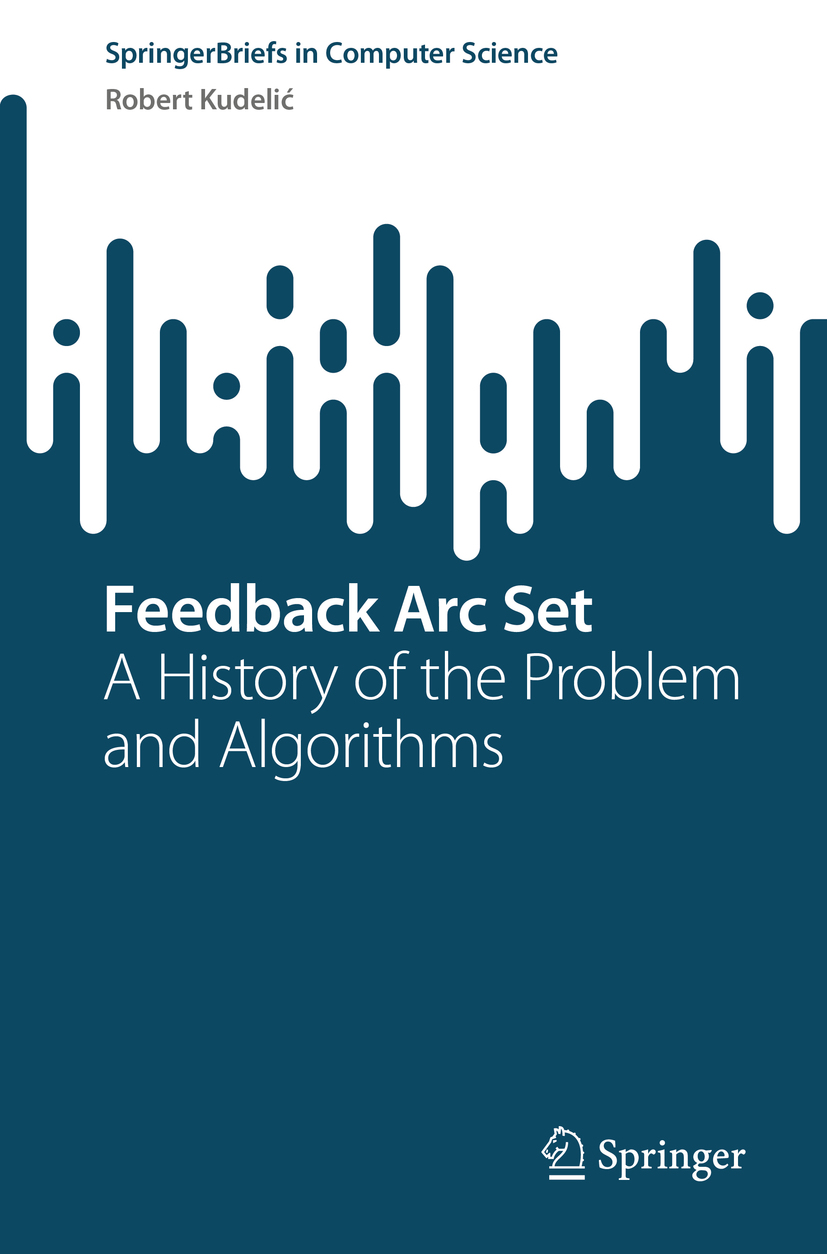
The primary objective of the book is to provide a comprehensive review of all pertinent material concerning Feedback Arc Set (FAS). This assessment inherently encompasses a history of the problem, along with particular algorithms. As of yet, no such work exists. The book consolidates material about FAS, including formulation, description, foundational theory, applications, algorithms, etc., in a single location.
This book represents a tour de force in the field of algorithm design for the feedback arc set (FAS) problem... it will serve as an excellent resource to researchers and students alike... to further extend the boundaries of the field. I strongly recommend this book for graduate students in computer science and operations research.
—Krishnan Subramani, PhD, Professor of the Lane Department of Computer Science and Electrical Engineering at the West Virginia University
View Book Supplementary MaterialMedia Articles

In a world dominated by data and algorithms, the concept of information plays a crucial role across various fields. From digital communications to biology and quantum physics, understanding how information works reveals fundamental truths about the universe. Scientists are now exploring the deeper meaning of functional information and its impact on complex systems.
Media Article Journal Article
News coverage in Robotics & Machine Learning (NewsRX) of research from the University of Zagreb Faculty of Organization and Informatics on an ant-inspired Monte Carlo algorithm for the Minimum Feedback Arc Set problem is reporting gains in efficiency and convergence while retaining the ability to find an optimal solution with arbitrary probability under tighter probability bound which represents an important milestone for this hard and practically relevant computer science problem.
Media Article Journal ArticleSample Publications
https://doi.org/10.1016/j.array.2026.101011
https://doi.org/10.1038/s41598-025-89487-y
https://doi.org/10.1186/s40854-025-00759-y
https://doi.org/10.1016/j.jocs.2024.102454
https://doi.org/10.1007/978-981-99-3761-5_57
https://doi.org/10.1016/j.eswa.2018.12.021
https://doi.org/10.1016/j.asoc.2015.12.018
Career
The proposed research seeks to answer the question of how quantum computing and artificial intelligence algorithms (and potentially others) can act as enablers for generating entrepreneurial outcomes in the early stages of the entrepreneurial process so as to establish the scientific foundations of algorithmic entrepreneurship as a new phenomenon at the intersection of entrepreneurship, information sciences, and computer sciences
Integrating insights from entrepreneurship theory, information science, and computer science so as to provide an interdisciplinary foundation for new or innovative algorithmic approaches for hard computational problems
Examination of the possibilities, benefits, and obstacles associated with the integration of artificial intelligence, business intelligence, and quantum information science in the management of business processes and organizational systems
The project will create the European Digital Center for Innovation to help companies and stakeholders shift digitally; AI & Gaming EDIH will provide AI, cyber-security, and/or high-performance computing services for Digital Europe 2021-2027; AI & Gaming EDIH will focus on artificial intelligence, video game creation, gamification, blockchain, and IoT; SME and public administration digital transformation and skills development are the project's key goals
The project will hold six events in SR, HR, BL, CZ, and BA to teach citizens how to manage volunteering in crises and the importance of digital content accessibility for PwDs in almost all aspects of life while partners will provide documentation and workshops to help citizens manage local efforts for the project's two main pillars
Developing occupational standards, qualifications, curricula, and teaching materials for the Specialist in Video Game Development and professional development programs in the field; modernizing and developing teaching materials for the Technician in Video Game Development; and implementing adult education professional development programs and organizing professional training
Exploration of certain aspects of graph databases and an extension to the Neo4j system
New methods for teaching programming with special emphasis on teaching individuals with eyesight impairment are being developed to ensure inclusivity in the tech field
Massively multiplayer online role-playing games allow us to study two important computing topics: large-scale virtual social interaction and the design, development, and coordination of large-scale distributed artificial intelligence; the key question is how agents organize to perform their tasks and achieve their goals: we will use an empirical and theoretical approach to answer this question
The research is aimed towards the development and formalization of organizational design methods for multi-agent systems in the Internet of Things; the team will develop a semantic wiki about organizational design methods, as well as a formal ontology to foster further development of software engineering techniques for agent organizations
The project investigates areas of IS design that can be automated by creating computer algorithms to automate certain IS design procedures
The aim of the project is to explore new possibilities of extending the formal KPL language (modal logic that results from extending propositional logic by epistemic modal operators) and UML
7th World Symposium on Artificial Intelligence
Proceedings published by IEEE
ICT and Electronics Convention MIPRO: Optoelectronics, Photonics, Quantum Optics & Optical Computing
Proceedings published by IEEE
Novel and Intelligent Digital Systems
Proceedings published by Springer
10th International Conference on Information and Communication Technology
Proceedings published by Springer
Novel and Intelligent Digital Systems
Proceedings published by Springer
8th International Congress on Information and Communication Technology
Proceedings published by Springer
2022 International Conference on Frontiers of Artificial Intelligence and Machine Learning
Proceedings indexed by Scopus (Elsevier)
2020 International Symposium on Computational Intelligence
Proceedings indexed by Scopus (Elsevier) and Web of Science
Collaboration with the Pennsylvania State University and the University Paris Nanterre
Croatian finalist (world semifinalist) finish in the Software Design of the 2007 Imagine cup competition
Entrepreneurship and Small Business in the Storm of Digital Intelligence Technologies: Balancing between Promises and Risks
 US 10432700 B2 082-084-084-058-141
Profiles
Curriculum Vitae
For a document representation of my academic and professional experience, please download my PDF CV.
PDF